


How We Use Corneal Topography to Map Your LASIK Candidacy in Long Island City
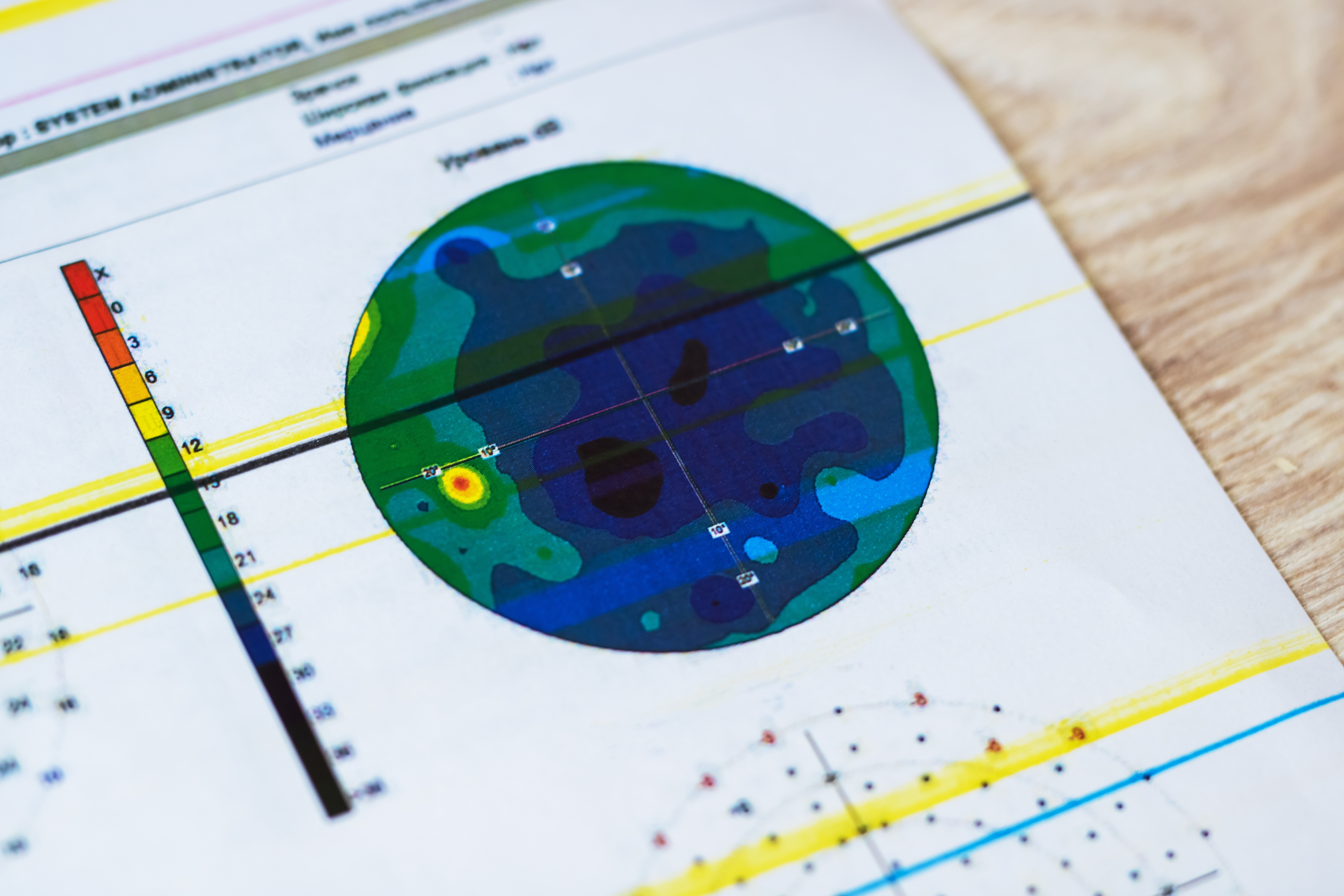
LASIK can reduce a patient’s dependence on glasses or contact lenses, but successful vision correction begins well before surgery. Every cornea has a unique shape, and that shape influences whether laser treatment can be performed safely and effectively. At Dussan Eye Care, we provide LASIK consultations and co-management for Long Island City patients considering refractive surgery.
Corneal topography gives us detailed information that a standard glasses prescription cannot provide. By creating a map of the corneal surface, this technology helps us evaluate its curvature, symmetry, and overall regularity as part of the LASIK candidacy process.
What Is Corneal Topography?
The cornea is the clear, curved tissue at the front of the eye. It helps focus incoming light onto the retina. LASIK changes the cornea’s shape to correct nearsightedness, farsightedness, or astigmatism, so understanding its structure is essential before recommending surgery.
Corneal topography is a quick, noninvasive test that measures how the surface curves across different areas. The results are presented as a detailed, color-coded map. Steeper, flatter, or irregular areas appear in different colors, allowing us to identify patterns that may not be visible during a routine examination.
Dussan Eye Care also provides information about iDesign Custom LASIK, which uses highly detailed measurements to create a personalized map of the eye for vision correction planning.
What We Look for on Your Corneal Map
A smooth, regular corneal shape may support LASIK candidacy, while certain patterns require further evaluation. During a LASIK consultation in Long Island City, corneal mapping can help us assess:
- The overall steepness and curvature of the cornea
- Differences between the center and outer corneal areas
- Regular or irregular astigmatism patterns
- Asymmetry between the upper and lower cornea
- Signs that may suggest keratoconus or another corneal disorder
- Changes caused by previous surgery, injury, or contact lens wear
- Whether additional testing or another vision correction option is needed
Preoperative corneal topography is important because it may reveal abnormalities that could make LASIK unsuitable. Patients with a history of corneal disease may not qualify for the procedure, and candidacy must always be determined individually.
Why Contact Lens Wear Can Affect the Map
Contact lenses can temporarily alter the shape of the cornea, particularly when they are worn regularly. If the surface has not returned to its natural form before testing, the measurements may not accurately reflect the eye’s true shape.
Patients may be asked to stop wearing soft, rigid gas-permeable, or specialty contact lenses for a specified period before their LASIK evaluation. The required time varies based on the lens type and the doctor’s instructions. Following these directions helps us collect more reliable measurements and avoid making decisions from a distorted map. The FDA also advises patients to expect a period without contact lenses before a LASIK evaluation and surgery.
Corneal Topography Is Only One Part of Candidacy
A favorable corneal map does not automatically mean someone is ready for LASIK. We also review the patient’s prescription history, general health, eye health, age, expectations, and current medications. A stable prescription for at least 12 months is one of the general candidacy guidelines discussed by Dussan Eye Care.
Additional testing may evaluate corneal thickness, pupil size, tear production, and the health of the retina and other eye structures. Dry eye should be identified and managed because LASIK can aggravate existing symptoms in some patients.
Coordinating Your LASIK Care
LASIK co-management connects your Long Island City optometrist with the refractive surgeon performing the procedure. We begin with a detailed examination, explain how the findings relate to your candidacy, and help coordinate the next stage of care. After surgery, follow-up visits allow us to monitor healing, visual improvement, and any symptoms that require attention.
Schedule your LASIK consultation with Dussan Eye Care at 10-16 50th Avenue, Long Island City, NY 11101, by calling (718) 784-3960.


Office Hours
- Monday 11:00am - 5:00pm
- Tuesday 11:00am - 6:00pm
- Wednesday 11:00am - 6:00pm
- Thursday 11:00am - 6:00pm
- Friday 11:00am - 6:00pm
- Saturday 11:00am - 3:00pm
- Sunday Closed
© 2026 Dussan Eye Care | All rights Reserved | Accessibility Statement | Privacy Policy | Sitemap
Powered by:
